

Anna University Exam Preparation: Your Ultimate Guide
Published: [Current Date]
Introduction
Anna University, a prestigious institution known for its rigorous academic standards, presents a significant challenge to its students each semester. With numerous engineering and technology programs, the examination process is a critical juncture for assessing learning and academic progression. This guide is meticulously crafted to equip Anna University students with the knowledge and strategies needed to navigate their upcoming exams with confidence and achieve stellar results. We delve into the nuances of the exam pattern, highlight crucial topics, and offer actionable advice for effective preparation.
Anna University Exam Information
Understanding the fundamental aspects of Anna University's examination system is the first step towards successful preparation. While specific details can vary slightly by department and year, certain core elements remain consistent. These typically include the duration of exams, the marking scheme, and the overall structure of assessments. Familiarizing yourself with these parameters allows for better time management and resource allocation during your study period.
Understanding the Anna University Question Pattern
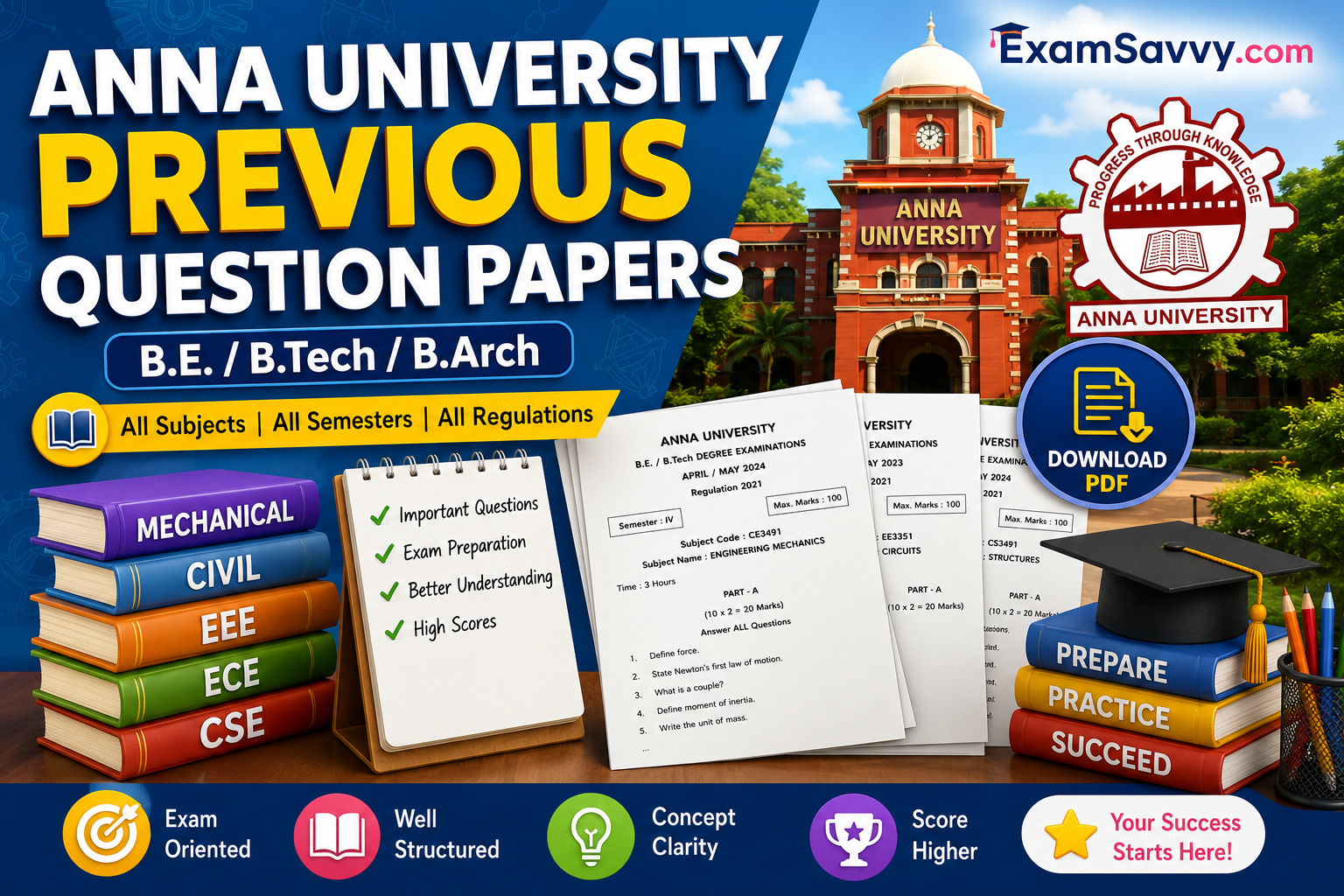
The question pattern is a blueprint that dictates the types of questions, their distribution, and the marks allocated. Anna University generally follows a pattern that aims to test theoretical understanding, application skills, and problem-solving abilities. While specific question paper formats might differ slightly across departments and subjects, you can expect a combination of:
- Part A: Usually comprises short answer questions, testing fundamental concepts and definitions.
- Part B: Consists of long answer questions, requiring detailed explanations, derivations, and problem-solving.
- Part C (sometimes): May include case studies or more complex analytical questions.
It's crucial to consult your department's syllabus and past question papers for the most accurate understanding of your specific subject's pattern.
Aligning with Course Outcomes (COs)
Anna University's curriculum is designed around specific Course Outcomes (COs). These are the measurable learning objectives that students are expected to achieve by the end of a course. Examiners often structure their questions to assess whether these COs have been met. Therefore, a key strategy for exam preparation is to:
- Review COs: Understand what each CO signifies and what skills or knowledge it aims to impart.
- Map Topics to COs: Identify which syllabus topics directly contribute to achieving each CO.
- Prioritize accordingly: Focus more attention on topics that are heavily linked to multiple or critical COs.
This approach ensures your studies are aligned with the university's learning objectives and increases your chances of answering questions effectively.
Identifying Important Topics
Identifying important topics is paramount for efficient study. This often involves a combination of:
- Syllabus Weightage: Pay attention to the emphasis given to different units or topics in the official syllabus.
- Faculty Emphasis: Listen closely to what your professors highlight as crucial during lectures and discussions.
- Past Papers Analysis: Repeatedly appearing topics in previous years' question papers are strong indicators of their importance.
By focusing your efforts on these high-yield areas, you can maximize your learning efficiency.
Spotting Repeated Topics in Past Papers
A thorough analysis of Anna University's past question papers is an invaluable tool. Look for topics that consistently appear across multiple years and examination sessions. These 'repeated topics' are almost guaranteed to be tested in your upcoming exams. Create a checklist of these recurring themes and ensure you have a deep understanding of them.
Anticipating Expected Questions
Based on the question pattern, course outcomes, and repeated topics, you can start to anticipate specific questions. For each important topic, try to formulate potential questions. Consider:
- Definition and Explanation: What are the core concepts?
- Derivations and Proofs: Are there any formulas or theorems that need to be derived?
- Applications and Examples: How is this concept applied in real-world scenarios?
- Comparisons and Contrasts: How does this topic relate to other concepts?
Practicing answers to these anticipated questions will build your confidence and refine your understanding.
Crafting an Effective Revision Plan
A structured revision plan is more effective than sporadic cramming. Your plan should include:
- Allocate Time: Divide your revision time among subjects and topics based on their difficulty and importance.
- Active Recall: Instead of passively rereading notes, test yourself frequently.
- Practice Papers: Solve as many past question papers as possible under timed conditions.
- Concept Consolidation: Revisit weaker areas and seek clarification from peers or faculty.
- Regular Breaks: Avoid burnout by incorporating short breaks into your study schedule.
Developing a Winning Exam Strategy
A well-defined exam strategy can make a significant difference on the day of the examination:
- Read Instructions Carefully: Always begin by thoroughly reading the instructions on the question paper.
- Time Management: Allocate a specific amount of time for each section and question. Stick to your schedule.
- Question Selection (if applicable): If you have options, choose questions you feel most confident answering.
- Prioritize and Attempt: Start with questions you find easier to build momentum, then move to more challenging ones.
- Neat Presentation: Ensure your answers are legible, well-organized, and include diagrams or figures where appropriate.
- Review: If time permits, review your answers for any errors or omissions.
Last-Minute Tips for Exam Success
In the final hours before your exam, focus on:
- Quick Revision: Skim through key formulas, definitions, and diagrams.
- Stay Calm: Avoid panicking. A calm mind performs better.
- Good Rest: Ensure you get adequate sleep the night before.
- Healthy Meal: Have a nutritious meal before the exam to maintain energy levels.
- Essentials: Carry all necessary stationery, admit card, and ID proof.
Frequently Asked Questions (FAQs)
- How much time should I dedicate to revising each subject?
- Allocate time based on the subject's difficulty, syllabus weightage, and your personal comfort level with the material. Prioritize weaker subjects.
- What is the best way to handle Part B questions?
- For Part B, focus on understanding the underlying concepts, providing detailed explanations, and backing your answers with relevant formulas, derivations, and examples. Structure your answers logically.
- Should I focus on solving only recent past papers?
- While recent papers are important, don't ignore older papers. Key topics often repeat over several years. Analyze a good range of past papers for comprehensive coverage.
- What if I encounter a question I don't know the answer to?
- Don't panic. Try to recall any related concepts or information. Even a partial answer showing understanding can fetch some marks. If possible, try to break down the question into smaller parts.
- How important are diagrams and illustrations?
- Diagrams and illustrations are crucial for explaining complex concepts, especially in subjects like Engineering. Ensure your diagrams are clear, well-labeled, and relevant to your answer.
Conclusion
Successfully clearing Anna University exams requires a strategic approach that goes beyond rote learning. By understanding the exam pattern, focusing on course outcomes, identifying important and repeated topics, and employing effective revision and exam strategies, students can significantly enhance their performance. Remember that consistent effort, smart planning, and a positive mindset are your greatest assets. Embrace the challenge, and you will undoubtedly achieve your academic goals.
Ready to Ace Your Exams?
Start implementing these strategies today! Share this guide with your friends and fellow students. For more study tips and resources tailored to Anna University, subscribe to our newsletter or check out our other related articles.